





The U.S. imposed additional duties of 50% on hundreds of Canadian product lines on 22 August 2026, and Canada's counter-tariffs of up to 50% apply to U.S. goods from 8 September 2026. For the first time in this dispute, a valid USMCA/CUSMA claim does not protect the shipment.
NEW U.S. DUTIES ON CANADIAN GOODS
President Trump signed three proclamations under Section 338 of the Tariff Act of 1930 on 20 July 2026, imposing an additional 50% duty on roughly 570 eight-digit HTS lines. They came into force on 22 August 2026 after extended last-minute negotiations between the United States and Canada eventually broke down.
Despite the proclamation titles (motor vehicles, dairy, alcohol), coverage reaches many consumer categories sold online:
- apparel & textiles, and leather goods
- cosmetics and essential oils
- jewellery, toys, sports and hockey equipment
- furniture, plywood, wooden kitchenware and stationery
- electronics, plastics and rubber articles
Goods already subject to Section 232 duties (steel, aluminium, copper, autos, wood products) are excluded and keep paying their Section 232 rate.
Updates: Effective 15 September 2026, the United States updated the list of affected products, adding another 122 eight-digit HTS lines affected by the additional 50% duty (and removing 10), taking the total to 680 eight-digit HTS lines.
From 29 September 2026, the United States banned the importation of selected alcohol and dairy products of Canadian origin (as well as motorcycles).
CANADA'S COUNTER-TARIFFS
Canada is responding with a surtax on some 630 tariff items worth C$27.6 billion of U.S. imports, effective 12:01 a.m. on 8 September 2026. Ottawa is matching Washington "rate for rate", so the surtax mirrors the U.S. rate on the same goods:
- 50% for apparel, cosmetics, electronics, plastic and rubber articles, sports equipment, plywood, pulp and paper, steel and aluminium, dairy
- 25% for carpets, cutlery, household metal articles, appliance parts, lumber, certain cheeses
It applies to goods eligible to be marked as a good of the United States under Canada's marking regulations. Goods in transit before 8 September are exempt, and the existing remission framework still applies. A third band of 15% covers industrial machinery.
IMPORTANT CLARIFICATIONS
- Origin decides, not where you ship from. Both measures follow the country of origin of the goods, not the country of dispatch. A Canadian-origin item sent to a U.S. customer from a European warehouse still attracts the 50%. A Chinese-origin item fulfilled from a Canadian 3PL does not. Into Canada, the same logic applies through the U.S. marking rules.
- USMCA/CUSMA no longer exempts the shipment. Unlike every previous round, the new duties apply to covered goods even when they qualify for preferential treatment.
- Duties stack, and the surtax lifts the tax base. U.S. Section 338 duties as well as Canadian counter tariffs sit on top of the general duty rate. Canadian GST is charged on the net customs value plus all duties.
- A preference claim is still worth making. It zeroes the ordinary duty rate and, into the U.S., exempts the goods from the separate 10% Section 301 forced-labour tariff in force since 24 July 2026. Into Canada, CUSMA removes the general customs duty as well.
CALCULATION EXAMPlES
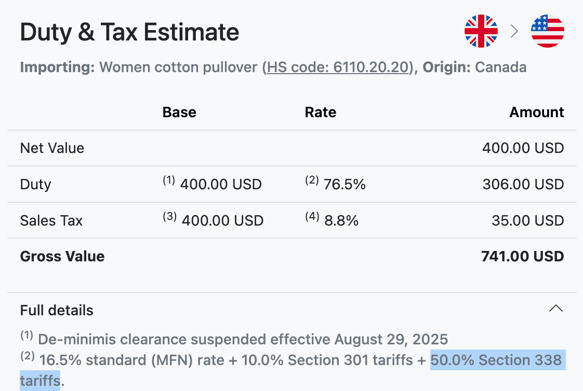
A women's cotton pullover (U.S. HTS 6110.20.20) manufactured in Canada, sold for USD 400 and shipped to the U.S. customer from a warehouse in the United Kingdom: the pullover is still a product of Canada, so the 50% Section 338 duty applies, and the route outside North America costs the USMCA preference, adding the 16.5% MFN rate and the 10% Section 301 tariff for a total duty of 76.5%.
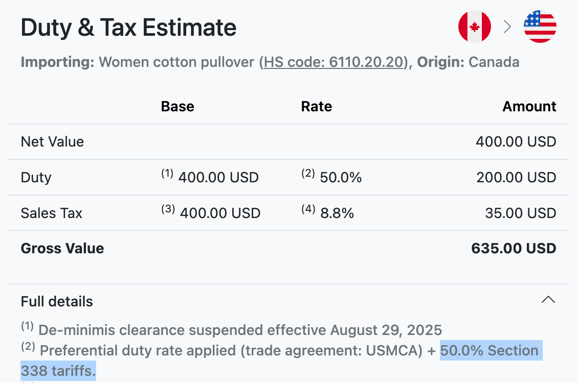
The same pullover shipped directly from Canada: the USMCA preference brings the ordinary duty to zero and exempts the Section 301 tariff, leaving the 50% Section 338 duty that no certificate of origin can remove.
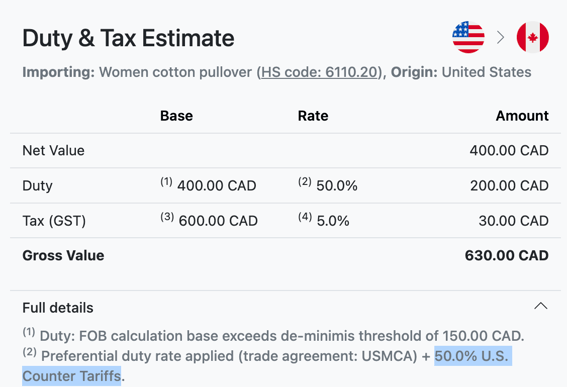
The same pullover produced in the United States and shipped to Canada: the USMCA preference brings the ordinary duty to zero, but the new 50% counter tariffs do apply.
WHAT MERCHANTS SHOULD DO NOW
Start by checking the impact on your own products: Glopal's online duty & tax calculator returns the landed cost for any product and destination, including the new duties and surtax.
Where the 50% cannot disappear into the margin, review the price of the affected products. And because both lists are defined at tariff-line level rather than by product category, reach out to Glopal if you would like us to screen your catalogue and flag what is affected.