




.jpg?width=300&name=getty-images-PhGyGmM6F_w-unsplash%20(1).jpg)
The temporary 10% Section 122 surcharge on U.S. imports expired on July 24, 2026. In a last-minute move, the U.S. replaced it with new Section 301 tariffs targeting 60 economies for failing to ban imports made with forced labor — at an additional duty of either 10% or 12.5%, depending on the country of origin.
SECTION 301 TARIFFS REPLACE SECtion 122 SURCHARGE
The 150-day Section 122 surcharge (see our previous post) reached its expiry on July 24, 2026. On the same day, the U.S. Trade Representative's new Section 301 forced-labor tariffs took effect, following investigations into 60 trading partners that cover over 99% of U.S. imports. The new rates depend on the product's country of origin:
-
10% additional duty applies to the following economies: Argentina, Bangladesh, Cambodia, Canada, Ecuador, El Salvador, the European Union, Guatemala, Honduras, India, Indonesia, Jordan, Malaysia, Mexico, Pakistan, Sri Lanka, Taiwan, Trinidad and Tobago, and the United Kingdom.
- 12.5% additional duty applies to: Algeria, Angola, Australia, the Bahamas, Bahrain, Brazil, Chile, China, Colombia, Costa Rica, the Dominican Republic, Egypt, Guyana, Hong Kong, Iraq, Israel, Japan, Kazakhstan, Kuwait, Libya, Morocco, New Zealand, Nicaragua, Nigeria, Norway, Oman, Peru, the Philippines, Qatar, Russia, Saudi Arabia, Singapore, South Africa, South Korea, Switzerland, Thailand, Turkey, the United Arab Emirates, Uruguay, Venezuela, and Vietnam.
- No additional duty for any other country not listed above.
AdDED ON TOP OR CEILING RATE
For most countries, this Section 301 duty is added on top of the standard MFN rate and any other tariffs. Goods already subject to Section 232 duties (e.g. steel and aluminium), informational materials, and certain listed products are exempt.
However, for five economies with a previously negotiated trade deal, the Section 301 duty is not added on top. Instead, it is applied "net of the MFN rate" so that the combined duty (MFN + Section 301) reaches a fixed ceiling:
- 10% ceiling for European Union and Taiwan: If a product's MFN rate is below 10%, Section 301 tops it up to a combined 10%. If the MFN rate is already 10% or higher, the Section 301 duty is zero.
- 12.5% ceiling for Japan, South Korea and Switzerland: If a product's MFN rate is below 12.5%, Section 301 tops it up to a combined 12.5%. If the MFN rate is already 12.5% or higher, the Section 301 duty is zero.
In short, for these economies the new tariff never stacks — it only fills the gap up to the ceiling.
CALCULATION EXAMPlE
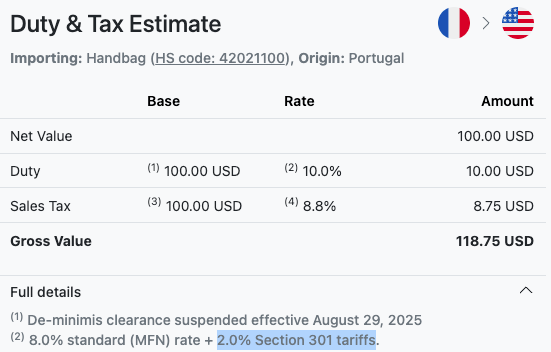
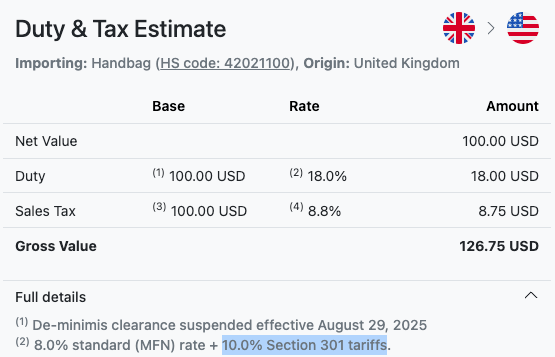
To see how this plays out, take the same leather handbag (HS 42021100) valued at $100, imported into the U.S. from two different origins. Both carry the same 8% standard MFN duty — the only difference is the new Section 301 forced-labor tariff.
EU-manufactured (origin: Portugal) — the ceiling case. Because the EU is capped at a combined 10%, only 2% Section 301 is added on top of the 8% MFN, for a total duty of 10% ($10.00).
Vietnam-manufactured, shipped from the UK — the top-rate case. The rate follows the country of origin — Vietnam, in the 12.5% group — not the country the parcel ships from. So the full 12.5% Section 301 stacks on top of the 8% MFN, for a total duty of 20.5% ($20.50).
Evaluate the impact on your products with Glopal's online duty & tax calculator.
POSTAL SHIPMENT EXEMPTION EXPIRED
From July 24, standard duties — including MFN (Most Favored Nation), Section 301, and Section 232 — apply to postal shipments for the first time. These have applied to commercial shipments since August 2025, so the two channels are now treated the same way, ending the temporary postal advantage.
At the same time, the prepaid-duty (DDP) threshold for postal shipments rises from $800 to $2,500.
OUTLOOK: MORE TARIFFS MAY FOLLOW
Merchants should expect further changes in the near future.
An ongoing second round of investigations targets 16 trading partners — including China, several other Asian economies, and the European Union — over what the U.S. describes as "excess capacity," or the overproduction of certain manufactured goods. Those rates have not been finalised.
We will continue to update merchants as new measures are confirmed.