





The pace of global trade regulation changes is accelerating faster than ever. Here is a summary of the latest relevant changes to cross-border e-commerce businesses.
📦 LOW-VALUE PARCEL CHARGES
New national handling charges for low-value shipments are actively rolling out:
- 🇳🇿 New Zealand: Effective April 1, 2026, New Zealand customs has introduced a strict per-consignment goods management levy of NZD 2.21 (plus 15% GST) for air freight imports valued at NZD 1,000 or less. For sea freight, the charge is NZD 2.09.
- 🇮🇹 Italy: The new €2.00 handling fee for sub-€150 shipments has been officially paused in March until (at least) June 30, 2026.
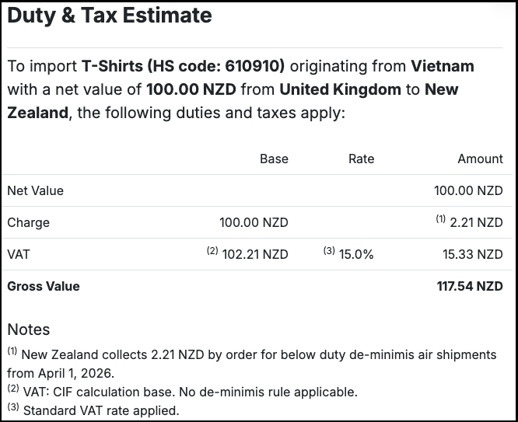
Glopal Support: Glopal's Duty & Tax engine automatically applies low-value parcel handling fees for France, Romania, and New Zealand. Glopal actively monitors the roll out and changes of such fees in other markets.
Sources: New Zealand Customs and Italian Ministero dell'Economia e delle Finanze
🇺🇸 U.S. Tariff Changes
The U.S. customs landscape has abruptly shifted following the Supreme Court's decision to invalidate former IEEPA rates in late February 2026:
- Current Rate: A flat 10% Section 122 surcharge is now added globally on any imports, replacing previous country-specific IEEPA tariffs. This interim surcharge is legally capped at a strict 150-day duration, meaning it will have to expire latest on July 24, 2026.
- Future Outlook: The U.S. administration explores replacing the temporary surcharge with Section 301 tariffs - U.S. trade penalties authorized under the Trade Act of 1974 to combat unfair foreign practices. This would mirror the framework applied to Chinese products since 2018 with rates from 7.5% to 100% on wide-ranging goods.
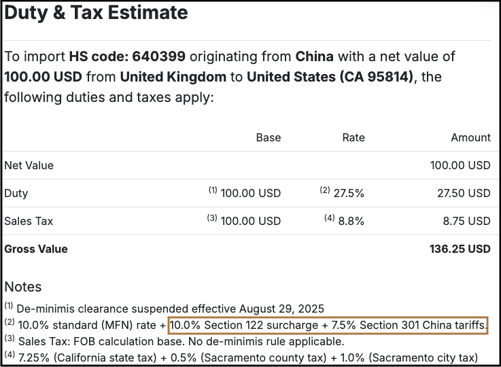
Glopal Support: Glopal's Duty & Tax engine reflects up-to-date tariffs (currently the flat 10% Section 122 surcharge), and is pre-configured to automatically pivot to specific Section 301 tariffs by HS code if and when implemented.
Sources: The White House - Fact Sheet
🇪🇺 EU: NEW TRADE AGREEMENTS SIGNED
The European Union has signed a wave of landmark Free Trade Agreements (FTAs) in the past months, which will - once in force - eliminate duties on the majority of EU-origin products.
- 🇦🇷 🇧🇷 🇵🇾 ��🇾 Mercosur: The long-awaited agreement with Argentina, Brazil, Paraguay, and Uruguay was finally signed on January 17, 2026, and is expected to be implemented in late 2026. It will dismantle historically prohibitive tariffs (which currently peak at 35% for clothing and shoes), drastically lowering the barrier to entry for South America.
- 🇮🇳 India: Signed on January 27, 2026, and expected to be in force in late 2026, import duties will drop to 0% for the majority of EU-origin products. This eliminates standard historical duties that previously averaged around 20%.
- 🇦🇺 Australia: Signed on March 24, 2026, and also expected to be in force in late 2026, this agreement will eliminate standard historical duties of mostly 5% on most EU-origin goods.
- 🇮🇩 Indonesia: Signed already in late 2025 and slated to become active in 2027, this FTA will eventually eliminate duties most of EU exports entering Southeast Asia’s largest economy.
Glopal Support: Glopal actively monitors the implementation dates. Once in force, Glopal's Duty & Tax engine and will automatically consider applicable trade agreements once in force.
Sources: European Commission on Mercosur Deal, India Trade Agreement Memo, Press Release on Australia, Indonesia Trade Agreement Text
🇬🇮 GIBRALTAR: NEW TAX & CUSTOMS UNION
Gibraltar's import framework is undergoing a fundamental overhaul, following the UK-EU post-Brexit agreement:
- New Transaction Tax: Marking the end of its long-standing VAT-free status, Gibraltar is implementing a new 15% levy on April 10, 2026. This charge will function as a sales tax applied to both local manufacturing and imports. The standard tax rate starts at 15% for 2026, increasing to 16% in 2027, and capping at 17% by 2028. A reduced rate of 5% will be applied on selected products such as children's clothing and footwear.
- Customs Union with EU: Expected for July 15, 2026, Gibraltar will officially enter a customs union with the European Union, removing physical border checks for goods arriving from Spain. Goods of EU origin will enter duty-free, whereas imports from all other regions will be subject to the EU Common External Tariff.
What This Means for Merchants:
- 🇪🇺 For EU-Based Merchants: Trade becomes frictionless. Goods flow across the Spanish border without standard EU import duties. However, EU merchants must now calculate and collect the new 15% tax at checkout to avoid margin erosion and border delays.
- 🇬🇧 For UK-Based Merchants: The dynamic shifts significantly. Because Gibraltar is now inside the EU customs territory, shipments from the UK are treated as external imports. UK merchants must clear EU customs procedures, apply the 15% Transaction Tax, and face EU Common Customs Tariff duties.
Glopal Support: Glopal's Duty & Tax engine and will automatically apply Gibraltar's new transaction tax and the EU Common Customs Tariff, where applicable.
Sources: HM Government of Gibraltar - Technical Note and European Council Press Release
Need help navigating these changes?
The global e-commerce landscape is shifting faster than ever, and maintaining compliance doesn't have to mean sacrificing your margins or slowing down your growth.
If you need assistance adapting your logistics, tax strategies, or landed cost calculations to meet these strict 2026 requirements, contact Glopal today. Our team of cross-border trade specialists is ready to help you seamlessly integrate these updates and keep your international checkout converting.